
Playbooks
The ABM Bottleneck Was Never Strategy. It Was Execution.
Everyone knows which accounts matter. Few can reach them this week. Why ABM stalls at execution, and what has to be true to run it without a data project first.
Ritesh Patel · August 24, 2026 · 10 min read
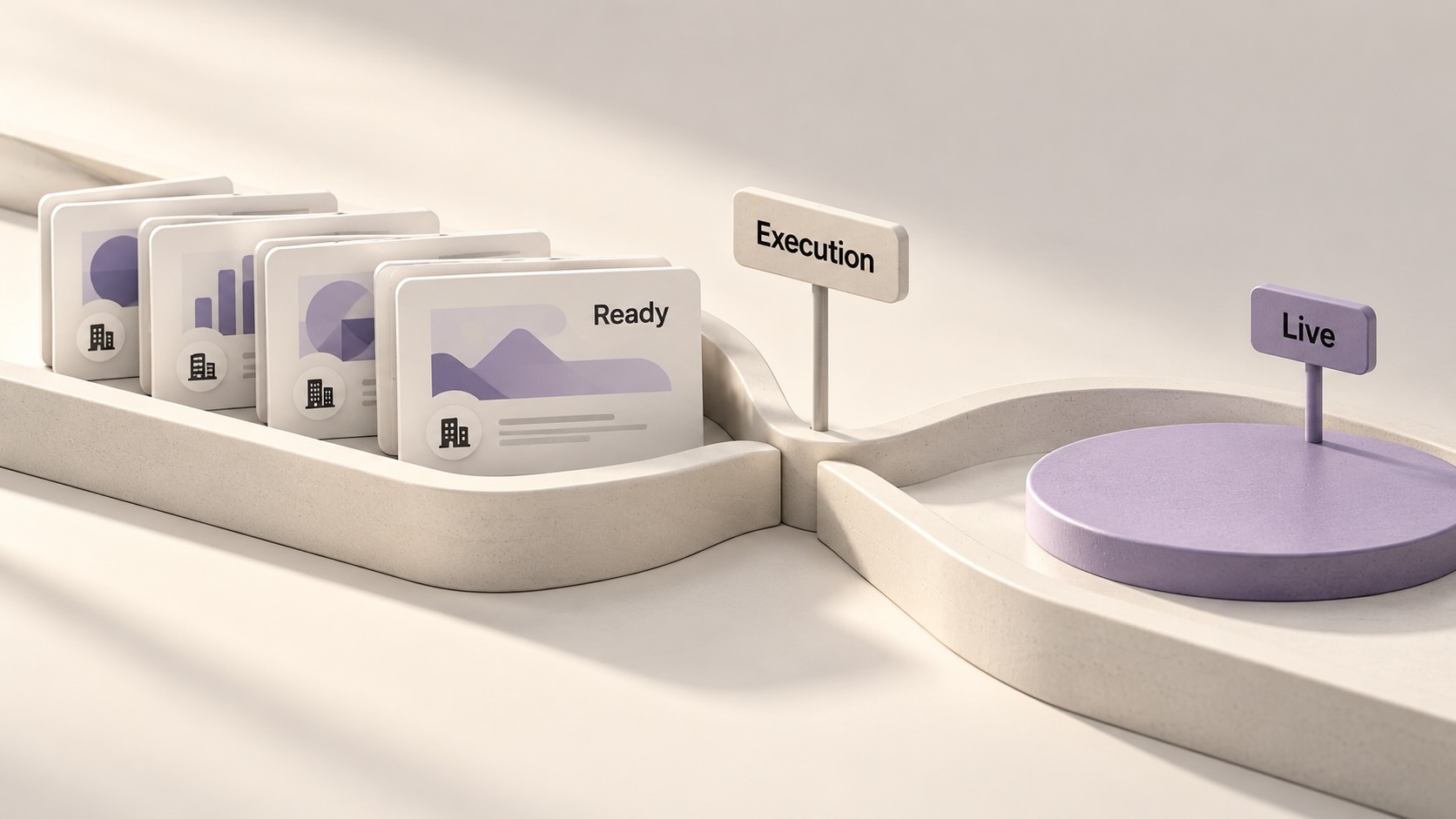
Everyone in the room can name the accounts that matter. The target list exists. The positioning exists. The ICP is agreed, the tiers are drawn, and the sales team already knows which logos would change the quarter. And yet the campaign that puts a relevant message in front of those accounts is not live this week. It is not live next week either. That gap, between knowing and reaching, is where most programs quietly stall, and it is an ABM execution problem, not a strategy problem.
Get new posts by email
Signals, playbooks, and what we're learning. No spam, and you can unsubscribe with one click.
This piece is about that gap. Why account-based programs stall at execution even when the thinking is done, what tax the setup keeps charging you, and what has to be true to run account-based advertising without a data project first. No theory you already agree with, and no pitch.
Why do ABM programs stall at execution?
ABM programs rarely stall because nobody knows which accounts to pursue. They stall because the work of reaching those accounts gets rebuilt from scratch every time. Here are the recurring causes.
- The setup is rebuilt each campaign. Targeting, structure, and audience logic get reconstructed per program instead of reused, so every launch starts near zero.
- Creative is stuck in a queue. Each variant needs a brief, a designer, and a review cycle, so the angle you want to test waits in line behind everything else.
- Spend is split across separate dashboards. Running the same accounts across several ad networks means several campaign managers, each with its own build, its own quirks, and its own babysitting.
- Measurement is rebuilt per network. There is no single view of what is working, so reporting becomes an assembly job before it becomes a decision.
- The account list ages while you wait. By the time everything is stitched together, the funding round, the exec hire, or the buying window that made an account interesting has moved on.
None of these is a thinking failure. Each is a mechanical failure, and mechanical failures compound.
Strategy vs execution: where ABM really breaks
The last decade of ABM education taught teams to treat account-based marketing as an operating model rather than a campaign. That lesson landed. Most teams now build a target account list, align it to the ICP, get sales and marketing pointed at the same logos, and sequence the buying committee instead of chasing single leads. The strategy layer is, for a large share of B2B teams, a solved problem.
So if the strategy is solved, why does the pipeline not move.
Because strategy and execution are two different jobs, and the industry keeps selling the first as the cure for the second. You can have a flawless account list and a sharp point of view and still be unable to get either in front of a buyer, because getting it in front of a buyer is a separate stack of work: constructing the targeting, producing the creative, launching across networks, and reading the results. That stack is the execution layer, and it is where the program breaks.
The uncomfortable version: a better strategy will not fix an execution bottleneck. It just gives you more good ideas to leave un-shipped.
The execution layer, decomposed
"Execution layer" gets used as a slogan more than a checklist. It is worth making concrete, because you cannot fix a thing you have not named. For account-based advertising, execution decomposes into four jobs.
Targeting construction. Turning an account list or a defined segment into live, in-market targeting on each platform. This is the step people assume is instant and is not.
Creative per network and persona. A message that works on LinkedIn does not work as a search ad, and a message for the economic buyer does not work for the champion. Real execution means genuinely distinct concepts across formats (text, image, and short-form video) and across the buying committee, not one asset stretched five ways.
Unified launch. Getting the same program live across the networks where your accounts are, without hand-building it five times. The five networks that matter for most B2B programs are LinkedIn, Google Ads, Meta, X, and ChatGPT Ads. Reaching an account usually means several of them at once.
Measurement. One read on what is working at the account level, feeding back into the next round of creative and budget on a weekly cadence, so decisions get made instead of deferred.
When people say a program "stalled at execution," they mean one or more of these four jobs became a project. Name which one, and you know where your bottleneck lives.
Why the integration project eats the value
Here is the assumption almost no one challenges: before you can run account-based advertising, you must first run a data project. Clean the CRM. Map the fields. Reconcile lead-to-account matching. Stand up the integrations. Only then, the story goes, are you "ready."
Sometimes that is true. Often it is a tax collected out of habit. The data-cleansing and mapping cycle gets rebuilt before every program, and by the time it clears, the effort you were trying to spend on reaching accounts has already been spent on plumbing. The value leaks out before the first impression.
Creative carries a similar hidden cost. The legacy creative cycle, briefing through delivery, runs roughly 14 to 21 business days across the market. That is a market benchmark, not a law of physics, but it sets the tempo most teams have quietly accepted: three to four weeks between wanting to test an angle and having the asset to test it with. Multiply that across a buying committee and five networks and the arithmetic gets grim. The account you wanted to reach this quarter gets reached, maybe, next quarter.
The point is not that data hygiene is worthless. It is that "fix the data first" and "produce every asset from scratch" are treated as fixed costs of doing ABM, when for account-based advertising specifically, a lot of that cost is optional if a few conditions hold.
What has to be true to run account-based advertising without a data project first
You can run account-based advertising before a full data-cleansing project, if a specific set of things is true. This is the honest version, with the tradeoffs named, not hand-waved.
What has to be true:
- You have a real account list or a defined segment. Named accounts, or clear firmographic criteria you can point at. This is the input that replaces the integration project, and you already have it.
- Your ad accounts are connected. Advertising still requires ad-account access on each network. This is the one piece of setup you cannot skip, and it is a connection, not a cleanup.
- You can produce creative without a three-week queue. Whether through native generation or a tight in-house loop, you need to make variants across formats and personas without a design ticket per test.
- You can launch and read across networks in one place. Not five separate builds and five separate reports, but one build and one view you can act on weekly.
- You accept account-level signals over perfect lead attribution, for now. You are optimizing toward reaching and engaging the right accounts, not waiting for the CRM to be pristine before you begin.
Here is the tradeoff, stated plainly. What you gain is time: campaigns in front of the right accounts while the window is still open, instead of a quarter of preparation. What you defer is the full closed-loop attribution and the deep CRM enrichment that a complete integration eventually gives you. Those still have value. They are a later step, not a gate you must clear before anything ships. You run the advertising now, and you do the data project on its own timeline instead of holding the program hostage to it.
Integration-first vs execution-first
The choice is easier to see side by side.
| Integration-first path | Execution-first path | |
|---|---|---|
| Time to first campaign | After the data project completes | As soon as accounts and ad accounts are connected |
| What you must fix first | CRM, field mapping, lead-to-account matching | Connect ad accounts; bring your account list |
| Where creative comes from | Design queue, per-asset briefs | Generated or produced natively, across formats |
| Number of dashboards | One per network, rebuilt each time | One unified build and read |
| What you defer | Nothing; you wait for all of it | Full closed-loop attribution and deep enrichment, done later |
Neither column is "wrong." The execution-first path just refuses to let the slowest possible prerequisite set the launch date for the whole program.
Execution as a category: the honest reframe
The market is starting to say this out loud. The story of the last two years of ABM tooling was not really about better strategy or better data models. It was about closing the execution gap. That is worth naming as its own category, because it changes what you evaluate tools on: not "does it have more account data," but "does it get a relevant campaign live in front of my accounts."
For a source-named read on this shift, MarketScale covered it directly in Most B2B ABM Programs Stall at Execution, and AI-Native Tools Are Being Built to Fix That. The framing there matches what operators have been living: the bottleneck moved from deciding to doing, and the tooling is finally being pointed at the doing.
Read past the vendor claims, and the durable idea underneath is simple. Strategy stopped being the scarce thing. Execution became the scarce thing. A category of tooling is now organized around that fact, Revscope among them, but the shift is bigger than any product: it is a correction in where teams should expect the friction to be.
A readiness self-check you can run this week
You do not need a new platform to test the diagnosis. You need ten honest minutes on your own program. Run this check.
- Name the bottleneck. Of the four execution jobs (targeting construction, creative, unified launch, measurement), which one turned into a project the last time you tried to launch? That is your constraint. Fix that one, not the strategy.
- Time the last variant. How many business days from "let us test this angle" to the asset being live? If it is near the 14-to-21-day market norm, your creative loop, not your account list, is setting your pace.
- Count the dashboards. If reaching your accounts means rebuilding across separate campaign managers and reassembling reports by hand, your execution cost is structural, and it will not improve by choosing better accounts.
- Question the prerequisite. Ask which parts of your "data project first" are genuinely required to advertise to named accounts, and which are habit. Then ask what would have to be true to start the advertising now and do the data work in parallel.
If you can name your bottleneck, you can stop spending strategy meetings on a problem that strategy cannot solve. The accounts are known. The point of the exercise is to reach them while it still matters.
Get started on your own accounts.
Twenty minutes. Name the accounts, keep the campaign either way.
Request a DemoComments
Loading comments.