
Playbooks
How to Evaluate an ABM Platform: A Neutral Buyer's Guide
A neutral, product-free guide to evaluating an ABM / B2B paid-media platform: the questions to ask about execution, data, automation, and cost before you sign.
Ritesh Patel · August 24, 2026 · 15 min read
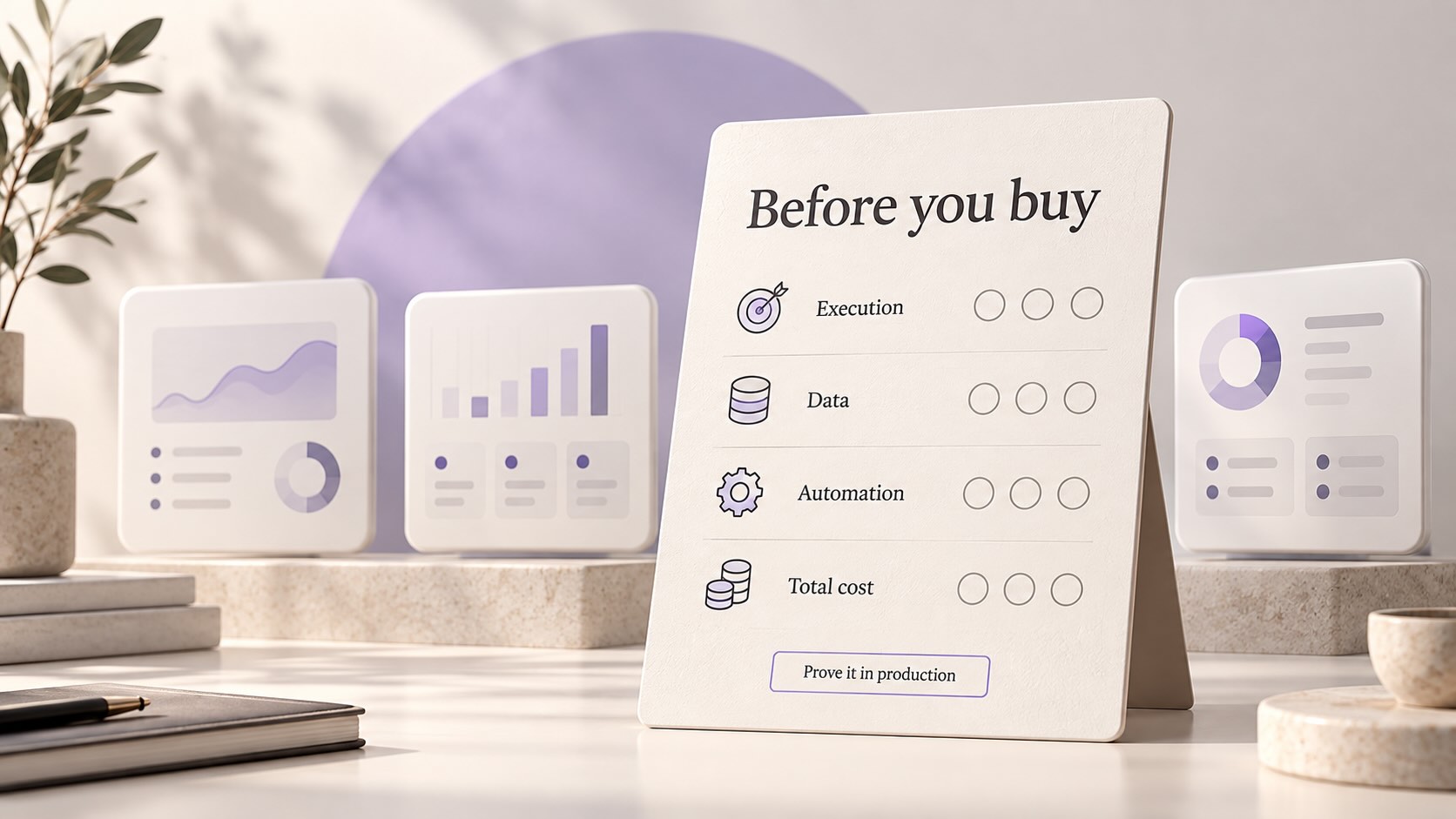
What to ask before you buy an ABM platform
Search "how to choose an ABM platform" and you will get a wall of buyer's guides. Read a few and you notice the pattern: almost every one is published by a company that sells an ABM platform, and every framework quietly arrives at the same conclusion, which is that the framework's author is the answer. That is what makes an ABM platform buyer's guide hard to trust. The criteria are real, but they are curated to flatter whoever wrote them.
Get new posts by email
Signals, playbooks, and what we're learning. No spam, and you can unsubscribe with one click.
This one names no favorite and ranks no product. It is a list of questions to take into vendor calls, each with why the question matters and what a weak answer sounds like. Use it against any tool you are shortlisting: a legacy ABM suite, an intent-data provider, a first-generation ad automation tool, or the manual multi-dashboard workflow you are trying to replace. The goal is a defensible choice, not a feature grid.
What questions should you ask before buying an ABM platform?
Before you sit through a single demo, write these nine questions at the top of your evaluation. They are the ones the vendor-authored guides tend to skip.
- Does it execute campaigns, or does it only enrich a list?
- How does it identify target accounts, and how is that identification verified?
- Can it show you its account-scoring model, or is scoring a black box?
- How does it behave when your CRM is messy, not clean?
- Where does a human stay in the loop, and where does the tool act on its own?
- Is the integration real production quality, or does it just "have a connector"?
- What is the total cost to operate, including the people and add-ons it needs?
- What do you keep if you leave, and how hard is it to get out?
- Can you run a proof of concept against production, not a staged demo?
The rest of this guide expands each of these, plus a question you should ask yourself before you ask a vendor anything.
First, do you need a platform or a data-project fix?
The disqualifying question comes before the shortlist: are you buying a platform, or are you trying to buy your way out of a data problem that no platform will solve for you?
A lot of ABM stalls get diagnosed as a tooling gap when the real issue is upstream. If your account list is out of date, your CRM ownership is contested, or nobody agrees on what a qualified account even is, a new platform will inherit all of that and make it more expensive. The vendor guides never raise this, because the answer they want is always "buy the platform."
So separate the two. If the blocker is strategy (you do not know who to target, or the business has not committed to named accounts), a platform is premature. If the blocker is data hygiene alone and you have the internal appetite to fix it, some of that work is unavoidable no matter what you buy. But if the blocker is execution (you know the accounts, you know the message, and you cannot get campaigns live without a queue, a services engagement, or a two-month setup), that is exactly what a platform should remove. Be honest about which of the three you are in. Buying execution software to fix a strategy gap is the most common way these purchases disappoint.
A useful test: write down the outcome you expect in the first 60 days. If it reads like "we will finally decide who to target," you have a strategy project. If it reads like "we will have account-based campaigns live across our channels without waiting on anyone," you are ready to evaluate platforms.
Execution vs enrichment: the split that matters most
This is the single distinction that reorganizes the whole ABM category, and most buyer's guides blur it on purpose.
Some tools enrich. They tell you which accounts are in-market, which contacts sit on the buying committee, and which signals are firing. That is valuable, but it ends with a better list. Something (or someone) still has to turn that list into creative, into targeting, and into live spend across your channels.
Other tools execute. They take account criteria or a segment and produce running campaigns: creative generated, audiences built, budget deployed across the networks you use. The list is an input, not the deliverable.
Neither is wrong. But they solve different problems and they are frequently sold with the same vocabulary, so a buyer can spend a full cycle believing a data platform will run their media and discover after signing that it hands off a spreadsheet at the exact point the work gets hard. Decide up front which side of the split you are buying, and hold every vendor to it.
The question to ask: "Walk me through what happens between your product identifying an account and an ad being live in front of that account. Which of those steps does your tool do, and which does my team still do?" The gap between "we surface the account" and "the ad is live" is where your real workload lives. Make the vendor narrate every step in it.
What a weak answer sounds like: "We integrate with your ad platforms." Integration is not execution. A connector that pushes an audience segment into an ad manager still leaves your team to build creative, structure campaigns, set budgets, and manage each network by hand. Ask what the tool produces, not what it connects to.
The questions the vendor guides skip
The featured questions above look simple. The value is in knowing what a real answer versus an evasive one sounds like. Here is the core of this guide as a table you can copy straight into your evaluation doc.
| Question to ask the vendor | Why it matters | What a weak answer sounds like |
|---|---|---|
| Does it execute campaigns or only enrich a list? | Enrichment ends with a better list; execution ends with live campaigns. Confusing the two means your team still does the hard part after you sign. | "We integrate with all the major ad platforms." Connection is not execution. |
| How does it identify accounts, and how is that verified? | Account identification quality decides whether you spend against real buyers or noise. Person-level, company-level, and modeled matches are not the same thing. | "We use AI and intent data." No source, no match logic, no accuracy check. |
| Can it show you its scoring model? | If you cannot see why an account scores high, you cannot defend budget decisions or catch when the model is wrong for your business. | "Our algorithm is proprietary." Proprietary is fine; unexplainable is not. |
| How does it handle a messy CRM? | Every buyer has imperfect data. A tool that assumes clean, mapped records fails on contact with reality. | "You'll want to clean your data first." That is your project, not their product. |
| Where does a human stay in the loop? | You need to know what the tool does on its own and where a person approves, edits, or overrides, especially on spend and creative. | "It's fully automated, you don't have to touch it." Ask what it does when it is wrong. |
| Is the integration production quality or just present? | A logo on a partner page is not a working sync. Field mapping, refresh frequency, and error handling decide whether the integration survives real use. | "Yes, we have a Salesforce connector." Existence, not quality or depth. |
| What is the total cost to operate? | License is one line. RevOps hours, data add-ons, creative production, and per-network management are the rest of the bill. | Only a per-seat or per-account license number, with everything else "depends." |
| What do you keep if you leave? | Audiences, creative, scoring history, and reporting can all be locked in. Portability determines your switching cost before you ever want to switch. | "Most customers don't leave." Not an answer to what you take with you. |
| Can you run a POC against production, not the demo? | The demo is the best-case highlight reel. Your data and your channels are where the tool is judged. | "Here's a sandbox with our sample data." Their data proves nothing about yours. |
A few of these deserve a longer note.
Messy CRM handling. Almost every vendor demo runs on clean, well-mapped sample data. No buyer has that. The gap between the demo dataset and your real CRM (duplicate accounts, half-filled fields, disputed ownership, five spellings of the same company) is where a lot of ABM tooling quietly breaks. Ask the vendor to run the proof of concept on an export of your real records, warts included, and watch what happens. A tool built for reality will absorb the mess and still target correctly. A tool built for the demo will tell you to fix your data first, which turns your purchase into a data-cleansing project you did not budget for.
Scoring transparency. Account scoring drives where your money goes, so a black box is a governance problem, not just a curiosity. You do not need the source code. You do need to see the inputs, understand the general logic, and be able to ask "why is this account rated a 9?" and get a real answer. If scoring is fully opaque, you cannot audit it, you cannot explain a budget decision to your CFO, and you cannot catch the moment the model starts optimizing for the wrong thing. In the proof of concept, pick five accounts you know well and ask the tool to justify each score. The quality of that explanation tells you most of what you need to know.
The human-in-the-loop line. Automation is a selling point until it spends your budget on the wrong accounts overnight. For every action a tool takes on its own (building an audience, launching a campaign, shifting budget, generating creative), ask where the human approval or override sits. There is no single correct answer, but there is a correct answer for your team's risk tolerance, and you want to know it before, not after. "Fully hands-off" is a feature to some buyers and a liability to others. Make the vendor draw the line explicitly.
Integration quality versus existence. "We integrate with Salesforce and HubSpot" is on every vendor's website and it tells you almost nothing. Ask which objects and fields sync, in which direction, how often, and what happens when a sync fails. Ask to see the field-mapping interface during the demo. A shallow integration that pushes a static list once is a very different thing from a two-way sync that keeps account status, campaign membership, and engagement current. The word "integration" is doing a lot of hiding here.
Total cost to operate. The license is the visible number and often the smallest one. The real total includes the RevOps and marketing-ops hours to run the tool, the data add-ons that get upsold once you are inside, the creative production the platform does not cover, and the per-network campaign management if the tool only pushes audiences rather than running media. Build the fully loaded operating cost before you compare license prices, because a cheaper license attached to a heavier operating burden is the more expensive choice. (Verify any pricing at the vendor's own current terms; this guide states no figures.)
Exit and portability. Ask the switching-cost question while you still have leverage, which is before you sign. What happens to your audiences, your generated creative, your scoring history, and your reporting if you leave? Can you export them in a usable format, or do they evaporate with the login? A vendor confident in its product will answer this cleanly. A vendor that treats your own data as a retention mechanism will get vague. The answer is a direct read on how the relationship will feel in year two.
How to run a POC that tests production, not the demo
The demo is the vendor's highlight reel. The proof of concept is where you find out if the tool works on your business. Structure it so it tests the real thing.
Bring your own data. Run the POC on an export of your real CRM and your real account list, not the vendor's sample set. If the tool cannot be evaluated against your data, that is itself a finding.
Pick accounts you already know. Choose ten to twenty accounts whose status you understand cold: some you know are in-market, some you know are not, a few that are ambiguous. Then check whether the tool's identification and scoring line up with what you already know. This is the fastest way to catch a model that looks impressive and is quietly wrong.
Define the outcome before you start. Write down what success looks like in a single sentence and share it with the vendor. "By the end of the pilot, we have account-based campaigns live across our channels, with scoring we can explain and creative we did not have to brief out." Vague pilots get graded on vibes; a defined outcome gets graded on results.
Time-box it and make someone own it. Give the POC a fixed window and a named owner on your side. Open-ended pilots drift until the champion loses interest and the tool gets bought or dropped on momentum rather than evidence.
Force the messy-data moment. Deliberately include the ugly parts of your CRM. Watch whether the tool absorbs duplicates, blank fields, and inconsistent naming, or whether it stalls and asks you to clean up first. The demo never shows you this. The POC is the only place you will see it before you sign.
Involve the operator, not just the buyer. The budget holder approves the purchase, but the ABM lead or demand-gen manager lives in the tool every day. Put the person who will operate it inside the POC and weight their read heavily. A platform the buyer loves and the operator dreads is a failed purchase on a delay.
A comparison scaffold you fill in yourself
Most comparison tables you find online are pre-filled by whoever wants to win the comparison. Here is an empty one instead. Copy it, put your real shortlist across the top, and fill each cell from your own vendor calls and POC. The blank version is the honest version.
| Criterion | Vendor A | Vendor B | Vendor C |
|---|---|---|---|
| Executes campaigns or enriches only | |||
| Account identification method + verification | |||
| Scoring model transparency | |||
| Messy-CRM behavior (from your POC) | |||
| Human-in-the-loop line | |||
| Integration depth (fields, direction, frequency) | |||
| Channels it can run media on | |||
| Creative: generated in-tool or your job | |||
| Fully loaded cost to operate | |||
| Data portability on exit | |||
| Operator verdict (not just buyer) | |||
| POC outcome vs your defined success |
Fill it from evidence you gathered, not from marketing pages. A cell you cannot fill is a question you have not yet forced the vendor to answer, which is useful to know before you sign, not after.
The one-page checklist to take into vendor calls
That is the whole guide. No product to recommend, because a neutral evaluation cannot have one. Here is the checklist condensed to a single page you can print and keep in front of you on every call.
Before you shortlist:
- Is my blocker strategy, data hygiene, or execution? (Only the third is a platform purchase.)
- What outcome do I expect in the first 60 days, in one sentence?
Ask every vendor:
- Does it execute campaigns or only enrich a list?
- How does it identify accounts, and how is that verified?
- Can you show me the scoring model and justify five real accounts?
- How does it behave on my messy CRM, not clean sample data?
- Where exactly does a human approve or override?
- Which fields sync, in which direction, how often, and what happens on failure?
- What is the fully loaded cost to operate, beyond the license?
- What do I keep, and in what format, if I leave?
Run the POC on production:
- My data, my account list, accounts I already know cold.
- A defined success sentence, a time box, and a named owner.
- The messy-data moment, forced on purpose.
- The operator in the room, with a weighted vote.
A buyer's guide is supposed to hand you the questions, not the answer. If a platform answers all of these cleanly and clears your own POC, you have a defensible choice, whichever logo ends up on the contract.
For more on where account-based execution tends to break, see the ABM execution problem. For how paid channels are shifting under ABM, see ChatGPT ads for B2B.
Get started on your own accounts.
Twenty minutes. Name the accounts, keep the campaign either way.
Request a DemoComments
Loading comments.