
Industry Insights
ChatGPT Ads for B2B: What They Can (and Can't) Do Yet
ChatGPT Ads is now self-serve. A neutral B2B primer on what the fifth paid surface can and cannot do yet, and why each new network adds its own cost.
Ritesh Patel · August 25, 2026 · 9 min read
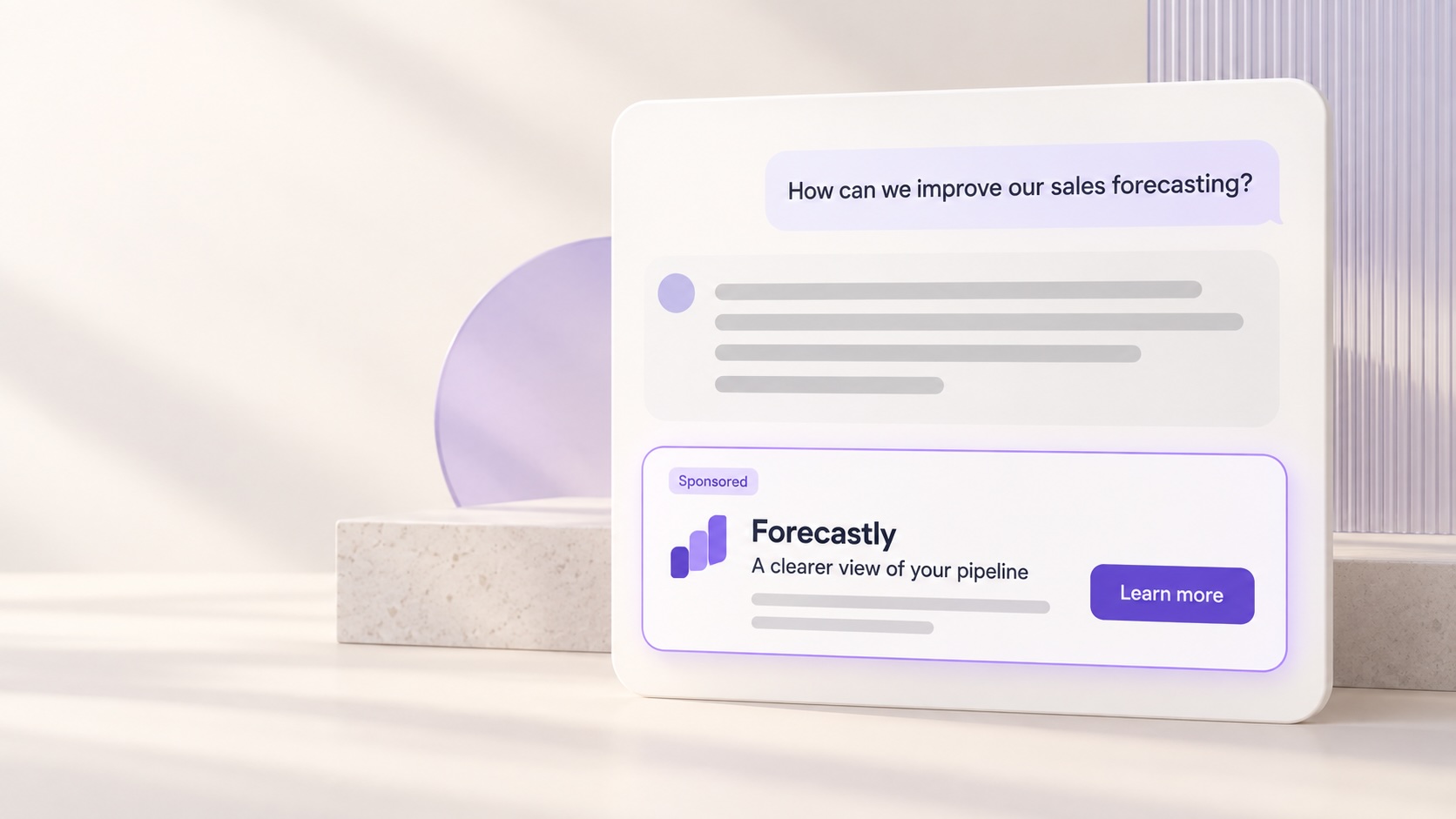
ChatGPT Ads for B2B: what they can (and can't) do yet
There is a new paid surface, and it is now self-serve. ChatGPT Ads moved from a closed pilot to a buyable beta this year, which means a B2B team can log into an ads manager and put a sponsored card in front of a conversation. That is genuinely new, and it deserves a straight read rather than a launch-day victory lap. This primer covers what ChatGPT Ads is, who sees it, what it cannot do for B2B yet, and how to decide whether to test it this quarter.
Get new posts by email
Signals, playbooks, and what we're learning. No spam, and you can unsubscribe with one click.
The honest headline first: the surface is real, the self-serve access is real, and the B2B limits are real too. All three are true at once. If you own paid media, the useful question is not whether ChatGPT Ads is exciting. It is whether a fifth network earns a slot in your workflow right now, and what it costs you to run it well.
What is ChatGPT Ads?
ChatGPT Ads are sponsored cards that appear below ChatGPT responses for Free and Go-tier users, matched to the conversational context. Advertisers buy them through OpenAI's self-serve Ads Manager (in beta), bidding on a CPC or CPM basis. Targeting is contextual and geographic, and measurement runs through a Conversions API and pixel.
Here is the short version for a buyer:
- Who sees them: Free and Go-tier users only. Paid tiers and users under 18 see no ads.
- How you buy them: through OpenAI's self-serve Ads Manager, in beta, with CPC or CPM bidding.
- What they cost: OpenAI has not published fixed rates. You set bids in the auction, so cost depends on competition and context.
Status as of August 2026
This surface is moving fast. As of August 2026, per OpenAI: ads have been live in ChatGPT since February 9, 2026 (a US pilot); a self-serve Ads Manager beta has been available since roughly May 5-6, 2026, adding CPC bidding alongside CPM plus a Conversions API and pixel for measurement; ads serve only Free and Go-tier users. Re-verify at the source before you rely on any detail here.
How ChatGPT Ads work and where they appear
The unit is a sponsored card. When a user asks ChatGPT something that maps to a commercial context, an ad can appear below the response as a distinct, labeled card. The match is contextual: OpenAI reads the conversation, not a firmographic profile, and serves a card it judges relevant to what the person is discussing right now.
That placement is the whole model. There is no feed to scroll, no sidebar inventory, no interstitial. The ad rides alongside an answer, in the moment the user is working through a question. For a reader mid-research on a category you sell into, that context can be valuable. For a reader asking about lunch, it is not your card's problem, because it will not show.
Buying happens in OpenAI's Ads Manager. As of August 2026, per OpenAI, the self-serve beta supports both CPM and CPC bidding, so you can pay for impressions or for clicks depending on your goal. Measurement is handled through a Conversions API and a pixel, the same server-side and client-side pattern most paid-media teams already run on other networks. If you have wired up a Conversions API before, the plumbing will feel familiar. What is different sits one layer up, in who you can reach and how precisely.
To ground this in the primary source rather than secondary coverage, OpenAI describes the pilot and its mechanics on its own announcement page. Source: OpenAI, "Testing ads in ChatGPT".
Who really sees them
This is the part most launch coverage buries, and it is the part a B2B buyer should read first.
As of August 2026, per OpenAI, ChatGPT Ads serve only Free and Go-tier users. Paid tiers see no ads at all. That single rule reshapes the reachability math for B2B.
Think about who inside a target account sits on a paid ChatGPT tier. It is often the people you most want to reach: the engineers, analysts, and operators who use the tool heavily enough to upgrade, and the executives whose companies bought them a seat. A meaningful share of senior B2B decision-makers are on paid tiers, which means your card will never render for them. You are reaching the Free and Go-tier slice of an account, not the whole buying committee, and you cannot buy your way past the tier gate.
This is not a reason to dismiss the surface. Free-tier reach is still reach, and plenty of relevant researchers, individual contributors, and earlier-career buyers use ChatGPT without paying. It is a reason to size your expectations honestly. On LinkedIn you can, in principle, reach a named account's whole committee. On ChatGPT Ads today you reach a tier-limited subset, matched by context rather than by who they are. Plan the budget around that reality, not around the total ChatGPT user count in a headline.
What it can't do for B2B yet
B2B paid media runs on precision: which company, which role, which stage. Here is the clean list of what ChatGPT Ads does not offer for that work as of August 2026, per OpenAI.
- No job-title targeting. You cannot narrow to VPs of Engineering or Heads of Security. Matching is contextual.
- No company-size or industry targeting. You cannot filter to 500-plus-employee firms or to fintech. The conversation is the only firmographic proxy, and it is a loose one.
- No ABM or named-account targeting. You cannot upload an account list and serve only to those companies. There is no account layer to target.
- No retargeting. You cannot build an audience of prior site visitors or engaged accounts and follow them into ChatGPT.
- Limited conversation-level reporting. Reporting is constrained, so the granular readout that a demand-gen team expects (which segments converted, which accounts engaged) is not there yet.
None of this is a flaw in the product so much as a description of an early surface. Contextual matching is a real targeting model; it is just a different one from the account-based precision B2B has built its playbooks around. If your program depends on named-account lists and role filters, ChatGPT Ads cannot execute that program today. If your program can work from context and geography at the top of the funnel, it can.
For the deeper contrast on why role-and-account precision matters, and how a per-network creative approach adapts to each surface's rules, see our notes on building distinct ad creative per network and the multi-network ABM execution problem.
The real cost is orchestration, not the CPC
Here is the frame that outlasts this quarter's news. The interesting cost of a new ad network is rarely the CPC. It is the orchestration.
Every surface you add wants three things of its own. Its own creative, cut to the format and the moment that surface rewards. Its own matching inputs, because a contextual card and a named-account campaign are fed very differently. And its own measurement, wired to that network's pixel and API and read in that network's reporting. Add ChatGPT Ads and you have not added one task. You have added a fifth creative brief, a fifth matching setup, and a fifth measurement integration, each with its own dashboard to check.
That is the quiet tax on chasing new surfaces one at a time. The legacy creative cycle alone is a known drag: a common market benchmark puts the turnaround on a fresh creative set at roughly 14 to 21 business days. Run that per surface, per variant, and a fifth network can stall for weeks before it serves a single card. The network is free to open. The workflow around it is not.
So the discipline is not "should we chase ChatGPT Ads." It is "can we build once and deploy across networks," so a new surface is a new output of an existing build rather than a new project. A unified build across the five networks (LinkedIn, Google Ads, Meta, X, and ChatGPT Ads) turns the fifth surface into a checkbox instead of a fifth campaign manager. That is the byproduct answer to the orchestration cost, and it is the lens worth carrying into any "new network just launched" moment: the question is how it folds into one build, not whether to add another tab.
Should you test ChatGPT Ads now?
A short decision guide, no hype either direction.
Test it now if: your top-of-funnel goal is awareness and category presence, your buyers skew toward researchers and individual contributors who use ChatGPT free, you sell into geographies OpenAI's beta covers, and you can produce a small, contextually relevant creative set without blocking your main channels. Treat it as a top-funnel experiment with a modest budget and clear read on cost per click, not as a replacement for account-based channels.
Wait if: your program lives or dies on named-account targeting and job-title precision, your buying committee sits mostly on paid tiers, or you need account-level reporting to justify spend to finance. The surface cannot serve that program yet, and forcing it will teach you little. Revisit when firmographic or account targeting arrives, and re-verify status at the source each time, because this space is moving month to month.
Either way, the useful takeaway is the same. ChatGPT Ads is a real fifth surface with real limits, and the winning move is not to sprint at it or to ignore it. It is to keep your build unified enough that adding a network costs you a creative variant and a measurement hookup, not a quarter. Add surfaces on your terms, size the reach honestly, and let the orchestration discipline, not the launch headline, decide the pace.
Get started on your own accounts.
Twenty minutes. Name the accounts, keep the campaign either way.
Request a DemoComments
Loading comments.